Freight Class Calculator

How It Works

The Freight Class Calculator estimates the density of your shipment in an easy and precise manner. Freight class in the context of logistics is based on the amount of space consumed by your package, the volume of the package, and its weight. The volume and the weight are both significant aspects to take into consideration when classifying the freight of your shipment. Higher density of a package implies that it occupies less area than it weighed. When the density is higher, the freight class tends to be lower and when the freight class is lower it tends to allow an overall reduction in shipping cost.

Processing Logic & Formula

In order to calculate the density of your shipment, there are certain steps to be taken. These are the steps to assist you in the conversion of your package weights and measurements into a value that recognizes the freight class properly.

1. Volume (Inches) = Length × Width × Height
2. Volume (Cubic Feet) = Total Inches / 1728
3. Density (PCF) = Total Weight / Cubic Feet

The resulting value of Pounds per Cubic Foot (PCF) is what finally discloses the group your freight will belong to, to be handled and to be charged properly.

Practical Example

Suppose a pallet of 48 × 48 × 48 inch size and a weight of 500 pounds. Divide the length, width, and height to determine its volume that equals 110,592 cubic inches. Division of this by 1,728 gives 64 cubic feet as the volume. The next thing to do is to calculate the density by dividing the total weight, 500 pounds, by the volume expressed as cubic feet. This provides a density of about 7.81 pounds per cubic foot (lbs/ft 3 ). This density is calculated to fit into the standard shipping bracket to classify the appropriate freight.
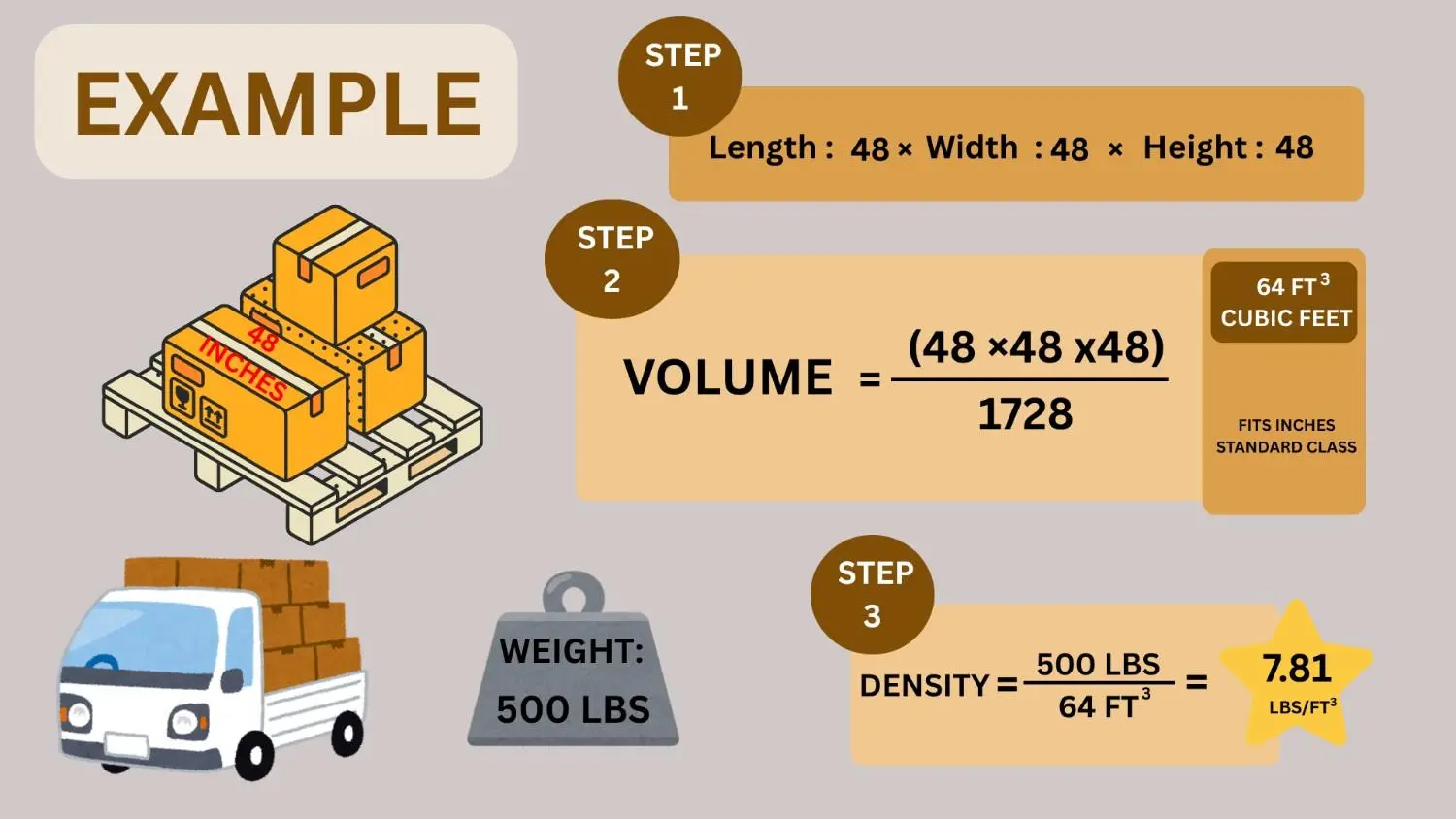
Freight Class Density Example

What Your Result Means

By determining the volume and density of your shipment, you can know the way your package will be shipped. These values provide an idea of the space it would use and the weight that influences the freight type allocated.

Volume: Shows the amount of space that your shipment will occupy in the truck.
Density: In case the density is above 15 PCF, the freight class will be reduced. In case the density is lower than 1 PCF, the freight class can be 500 which is the highest and frequently more costly.

Being aware of these values gives you a chance to be sure that your shipment is categorized properly and prevent mistakes associated with the classification.

Important Disclaimer

*Note: This calculator gives you the density of your shipment only. The last freight classification is decided by carriers based on NMFC (National Motor Freight Classification) regulations. Other factors that are considered by these rules include the handle-ability and stow-ability of your package. Although this calculator allows estimating the freight class according to the density, the official classification of the carrier can be different according to these other handling and storage factors.

Freight Class calculator

Accurately Calculate Your Freight Class in Seconds

Check your Freight Class 100 in seconds and with precision using our advanced Calculator. All you have to do is key inthe length, width, height and weight of your shipment and the tool will automatically calculate shipment density to find the appropriate NMFC freight class which will save you time, money and the needless reclassification fees.

The most common medium-density cargo is Freight Class 100 and selecting the right class is the key to the accuracy of the cost of LTL shipping. Shippers, freight brokers and logistics professionals have placed their trust in our optimized calculator that has been optimized to be searched by the terms of the search engine (SEO). 

Be it the shipment of LTL freight, or freight rate comparison, our calculator will assist in accurate freight classification, reduced billing payment controversies, and fluent freight flow.Calculate your Freight Class 100 today and ship with confidence.

Free Freight Class Calculator Tool

To find out the appropriate NMFC freight class to use when shipping a particular shipment, use our Calculator Tool. The tool will be simple and precise to use and will help you avoid wrong classification and LTL freight fees as a result of misclassification due to changes in shipment size, weight and density. All you need to do is to input the length, width, height and weight of your freights and the calculator will automatically show the appropriate freight class. The tool is an excellent LTL shipper, freight broker and logistics professional tool to determine the rate quotes and conduct freight efficiently and promptly; it requires quick and dependable freight class calculations. 

Our Freight Class Calculator also accommodates most of the common freight classes like Class 80 and it adheres to the normal NMFC density rules to provide reliable answers at all times. Get the Free Freight Class Calculator that is precise and easy to use when calculating freight.

What Is Freight Class?

Freight class is a standardized methodical classification scheme that is defined by the NMFC (National Motor Freight Classification) which defines the pricing and treatment of LTL freight. Shipment density is the most commonly used in determining freight class and other criteria include stowability, handling and liability. The 18 freight classes are between Class 50 and Class 500. Lower freight classes consist of more compact and easily transportable freight with lower shipping rates whereas higher classes relate to lighter, heavier as well as delicate items that are more expensive to transport. 

The proper choice of freight class is important to charge the right freight rate, avoid reclassification charges, and deliveries delays. Understanding freight class helps shippers and freight brokers calculate shipping costs correctly and ensure compliance with NMFC guidelines.

How Freight Class Is Calculated

The calculation of freight class is mostly based on the weight density of a shipment, which is computed by dividing the mass of the freight by the cubic volume.  To determine freight class, shippers would measure the length, width, and height of the shipment, total cubic shipment it occupies and compare the density it provided to the NMFC freight class density chart. 

Besides the density, handling, stowability and even liability can also play a role in final classification. Freight class determination is a crucial component of LTL shipping because it will guarantee that the correct freight rates are quoted, no reclassification charges are incurred, and shipments are safely transported within the carrier network.

Why Choose Our Freight Class Calculator?

Free Freight Class Calculator is a dependable, quick, and precise NMFC freight Class Calculator to ship with confidence. Our tool lowers the chance of freight being reclassified, adjustment of billing, and unwanted shipment costs in LTL because it calculates shipment density instantly.  The calculator, which is designed to be user-friendly, free and optimized in accuracy, is suitable for shippers, freight brokers, and logistics professionals, and the best tool to ensure that the freight class is always right.

Who Is This Tool For?

Fedex Freight Class Calculator is created to help any person interested in LTL shipping and freight management. It is perfect in the case of shippers, freight brokers, 3PLs, warehouse managers and small businesses that require correct determination of NMFC freight classes.  This tool is beneficial whether you are shipping once a month or freight on a daily basis to make sure that freight is classified and the rates quoted correctly and to facilitate your shipping business.

Call to Action

Our Calculator is easy-to-use, allowing you to calculate your freight class in seconds. Input your shipping information and obtain precise shipment results to save time, eliminate reclassification charges and ship confidently.

FAQs

1. What is freight class?

Freight class is a shipping standard category, which determines the price and handling of a shipment depending on density, size and weight.

Density is calculated by dividing weight of your shipment by its volume in cubic feet giving you Pounds per Cubic Foot (PCF).

No. The calculator merely provides an estimate of density. The carriers base the final freight class on NMFC rules.

Higher density implies that the package will take less space compared to its weight, which tends to decrease the freight class and shipping expenses.

Yes. The official freight classification can vary since the carriers can also examine handle-ability and stow-ability, besides density.

Scroll to Top